Not only apples are from Asia, but also many less commonly known fruits
that can be purchased in Chinese supermarkets. But which fruits are typically
Chinese?
Not only apples are from Asia, but also many less commonly known fruits
that can be purchased in Chinese supermarkets. But which fruits are typically
Chinese?
For sure the dragon fruit must be Chinese? According to a legend, a
dragon breathed out its last fire and afterwards the dragon fruit when being
killed. Another very plausible explanation for the name of the dragon fruit is
the look of the dragon fruit’s flowers: they look like a fire breathing dragon
(see pictures)! Clearly these stories and associations must
come from the land of dragons? Although the story might, the dragon fruit (Pitaya)
itself doesn’t: it is from Central America, most likely Mexico.
 |
| Dragon fruit. (Image source: Snapwire /Pexels) |
Kiwifruits often have a sticker from New
Zealand, because
Kiwis are from New Zealand, aren’t they? This could easily be assumed because
New Zealand is famous for its Kiwis – the birds as well as the fruits. Surprisingly,
however, another name for Kiwis is “Chinese gooseberry”! How comes? This is
because Kiwis originally came from north-central and eastern China! Kiwi seeds
were brought by a teacher, Mary Isabel Fraser, from Yichang (Hubei) back to her
home country New Zealand in 1904, from where the first commercial production of
the fruit started.
Fruits that are commonly and rightly associated with China are
Lychees. They are native to the tropical climate of the Guangdong and Fujian provinces
in South China. The name of the fruit “Longan”, which is similar to Lychees,
means “dragon eye” because the dark core seems like the iris of an eye
shimmering through the translucent pulp. Also similar to Lychees are the fruits
Rambutan and Pulasan, which originate from the Malay Peninsula and which have a
more hairy (Rambutan) or spiky (Pulasan) appearance.
 |
| Lychee. (Image source: Nikiko / Pixabay) |
 |
| Longan. (Image source: Bigtreegroup / Pixabay) |
 |
| Rambutan. (Image source: Goplaces / Pixabay) |
If discovering a new, unknown fruit, it is easiest to relate it to
something known. This might be the reason why there seem to be some “Chinese
versions” of fruits that are common in other places of the world with the names:
Chinese pear, Chinese dates, Chinese plums or Chinese strawberries.
 |
| Nashi pear. (Image source: 41330 / Pixabay) |
The Asian or Chinese pear, also called Nashi pear is a pear that has the
shape of an apple, a very light colour and is very crisp in texture (Cultural
note: do not share a pear with a friend or someone you love in China! “Sharing
a pear” 分梨/fēnlí sounds like “to separate” 分离/ fēnlí in Chinese.).
 |
| Chinese dates (Jujube). (Image source: xbeing/ Pixabay) |
 |
| Dates. (Image source: jackmac34 / Pixabay) |
Chinese dates (Jujube) grow in southern Asia including southern and
central China. In contrast to the dates originating from the Middle East, which
are brownish and rod-shaped fruits that grow from palm trees, Chinese dates are
red and more oval to round fruits that grow from thorny shrubs.
 |
| 梅子/ méizi. (Image source: PublicDomainPictures / Pixabay) |
Chinese plums (Prunus mume, 梅子/ méizi) originated in the
south of China around the Yangtze River and are related to plum and apricot
trees. Besides culinary uses they are used in traditional Chinese medicine and
their blossoms are regarded as symbols for perseverance, hope and purity but
also the transitoriness of life. Also called “Chinese plums” are Loquats (枇杷 / pípa), which look different from plums as they contain several seeds
in one fruit. Loquats are, besides their culinary use, also used in traditional
Chinese medicine and as an ingredient of cough drops.
The Chinese strawberry (Myrica rubra or杨梅/ yángméi) originates from
south-central China and besides eating them freshly they are often processed to
juice or alcoholic beverages. Attention, in contrast to strawberries they
contain a seed inside!
 |
| Asian Persimmon. (Image source: teerkrizkova / Pixabay) |
Chinese fruits that seem not to have been compared to pears, dates,
plums or strawberries are Wampee (Chinese provinces Fujian, Guangdong, Hainan,
Sichuan, part of Yunnan), Asian Persimmon (柿子/ shìzi, Japan,
China, Korea, Burma, Nepal) or the monk fruit (罗汉果/ luóhàn guǒ, Chinese province Guangxi,
Guangdong, Guizhou, Hunan, Jiangxi), which can be
used to produce a natural sweetener.
Typically Chinese is also the mulberry, which doesn’t only feed fruit
eaters but also the silkworm, for which mulberry leaves are the only food
source.
 |
| Mulberry. (Image source: janaprusova / Pixabay) |
The origin of Goji berries (枸杞 / gǒuqǐ) is not exactly
known because they are so widely spread, but dried Gojiberries are a popular ingredient
in some Chinese dishes, such as soup. Goji berries are said to lead to
particular health benefits but may under certain conditions also lead to unwanted
side effects.
 |
| Goji berries. (Image source: budtobloom / Pixabay) |
Because China comprises several climate zones, many fruits that originate
from other countries can be planted in China such as watermelons (originally
from Africa, grow e.g. in Gansu province), Physalis / lantern fruit (originally
from Peru, grows in northeastern China e.g. Heilongjiang). A fruit with a long
history in China is the pomegranate, which originates from Iran and the Middle
East and was introduced during Tang dynasty (618-907 AD). Due to the many seeds
they contain, pomegranates were considered as a symbol for fertility.
 |
| Pomegranate. (Image source: LeeTravathan / Pixabay) |
Fruits that are popular in China or in parts of China but originate from
other Asian countries:
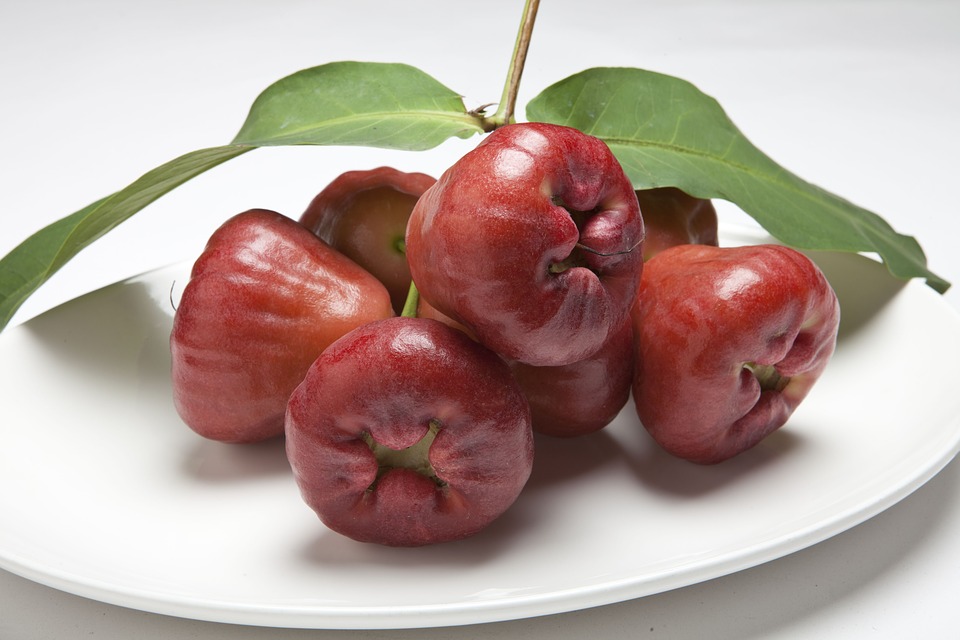
Mangosteen (native to Malaysia, Indonesia), wax apples (莲雾/ liánwù, native to Malaysia) and starfruit (Philippines, Malaysia,
Indonesia, Vietnam, Nepal, India, Bangladesh, Sri Lanka, Mauritius, Seychelles)
are not originally from but have become popular in China.
 |
| Mangosteen. (Image source: taboty / Pixabay) |
 |
| Wax apples. (Image source: gkgegk / Pixabay) |
 |
| Starfruit. (Image source: chrisad85 / Pixabay) |
Durian (Malaysia, Indonesia), a fruit that may also be sold in Chinese
supermarkets is loved by some and hated by others. Please note: Because its
smell might disturb other readers who are not used to it, it is not allowed to
eat Durian on this blog. There is a balcony connected to this blog, where you
are allowed to consume Durian. Enjoy! go to balcony
Noni fruits, native to Australasia were brought by seafarers from Polynesia
to Hawaii more than 2400 years ago. Noni fruits are said to be very healthy.
For consuming Noni fruits please go to the balcony, thank you.
Mango, a less controversial and widely known fruit grows e.g. in India
and the Philippines. Also from India are Jackfruits, which can be eaten as a
fruit but interestingly, unripe Jackfruits can also be processed to become a
meat-substitute.
水果 / shuǐguǒ / fruit
Sources and further reading:
A video teaching names of fruits in Chinese:
Dragon fruit:
https://en.wikipedia.org/wiki/Pitaya
Image of dragon fruit flowers looking like fire
breathing dragons:
Kiwifruit:
Lychee, Longan, Rambutan, Pulasan:
Chinese pear, pear:
Dates:
Plum:
Chinese Strawberries:
Wampee:
Monk fruit:
Goji berries:
Asian Persimmon/Kaki:
Mulberry:
Watermelon:
Physalis:
Pomegranate:
Mangosteen:
Wax apple:
Starfruit/Carambola:
Durian:
Noni:
Mango:
Jackfruit:
Chinese and Asian fruits: